Key Summary
- Senate repeal of federal ban: On July 1, 2025 the U.S. Senate voted 99-1 to strike a proposed 10-year moratorium that would have prevented states from regulating AI.
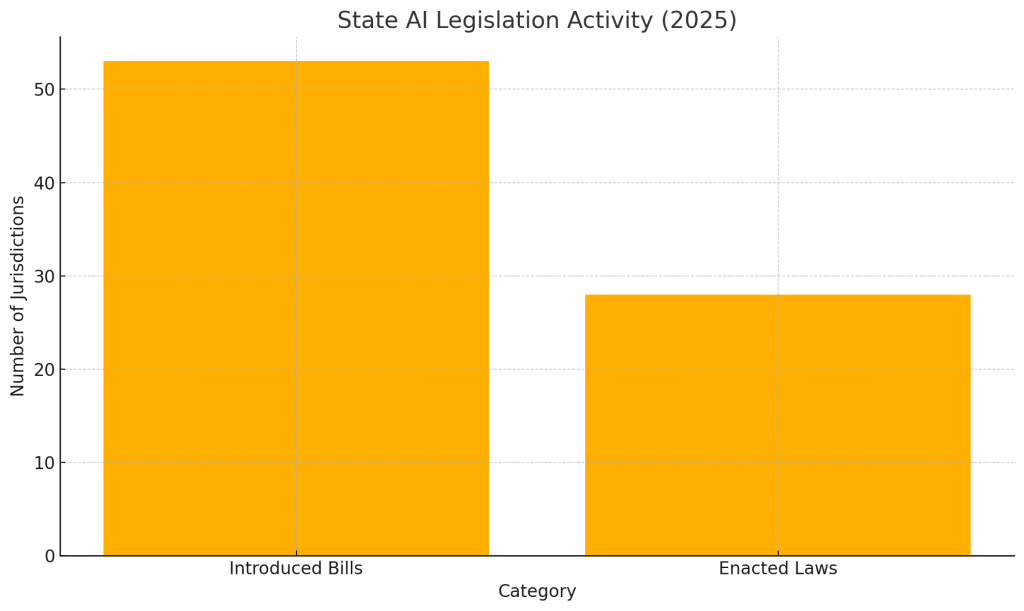
- Vigorous state activity: According to NCSL, all 50 U.S. states (plus DC, Puerto Rico and the Virgin Islands) have introduced AI-related bills in 2025, with 28 jurisdictions enacting new AI laws so far.
- Industry vs. states: Tech giants like Google and OpenAI had supported pre-emption to avoid a patchwork of rules. However, many governors and lawmakers (from both parties) pushed back, arguing states need authority to protect children, privacy, and local interests.
- Patchwork outlook: With no federal override, experts expect a diverse mosaic of state regulations. Many states are now focusing on narrower AI rules (e.g. data disclosures, youth safety and accountability) rather than broad AI Acts. Businesses will face a complex compliance landscape.
U.S. State vs Federal AI Regulation
In mid-2025, a contentious AI policy rider was removed from a major congressional package. The original provision (in a $1.8 trillion tax and spending bill) would have barred states from imposing new AI regulations for ten years. Amid opposition, Senators overwhelmingly voted to eliminate the ban. In debate, Senate Commerce Committee members noted that tech firms had lobbied for federal pre-emption, but critics – including Senator Blackburn herself – countered that states must not lose their consumer-protection powers. As Arkansas Governor Sarah Huckabee Sanders put it: “We will now be able to protect our kids from the harms of completely unregulated AI”. The final vote (99-1) signals that, for now, states remain free to govern AI as they see fit.
Federal Decision and Debate
The Senate’s decision reflects a broader clash over U.S. AI governance. Proponents of the moratorium argued a uniform federal approach would spur innovation by preventing inconsistent state laws. In fact, major AI companies like Google and OpenAI publicly supported taking AI regulation “out of the hands of states” to free innovation from a “panoply of differing requirements”. Opponents, however, warned that pre-emption would strip states of tools to address urgent issues.
Republican Senator Marsha Blackburn (who initially proposed the amendment) eventually joined efforts to remove it, agreeing that federal action should not nullify state laws. The close collaboration between governors and legislators against the moratorium – spanning concerns about online safety, copyright protection, and algorithmic harms – underscores the political improbability of blanket federal AI rules without broader consensus.
State-Level AI Legislation Overview
While federal policymakers debated pre-emption, states have moved ahead with their own AI agendas. NCSL reports that every U.S. state has introduced some form of AI legislation in 2025. So far 28 states (plus the U.S. Virgin Islands) have adopted or enacted new AI laws. These laws vary widely: some create task forces or advisory councils on AI use, others impose transparency requirements or ban specific practices (e.g. using AI to impersonate minors).
For example, Montana’s recently-enacted “Right to Compute Act” requires critical-infrastructure operators to develop AI risk-management plans, while also safeguarding citizens’ freedom to use computing resources lawfully. Similarly, Nebraska and Utah have passed laws protecting minors online (age-appropriate design codes and child-safety measures). In general, sweeping “AI Bills” like Colorado’s have largely stalled elsewhere, and states instead are passing targeted, use-case laws – on bias assessment, deepfake penalties, health chatbots, etc. – tailored to local priorities.
Implications for Industry and Harmonization
For businesses, the outcome means continuing to navigate a mosaic of regulations. The Senate’s move confirmed that no federal umbrella will pre-empt state laws for now. Companies must therefore track developments in multiple jurisdictions. Recognizing this, legal analysts note that many states are clustering around similar themes: transparency in AI use, protection of vulnerable groups, and rights related to AI-generated content.
In the absence of federal standards, industry and civil society are likely to push for some harmonization. Tech trade groups and Congress could still revisit federal legislation addressing specific issues (e.g. child safety online, data privacy) in order to establish baseline protections across states. Meanwhile, multi-state compacts or model laws (similar to those seen for data privacy) could emerge to reduce fragmentation.
Policy Recommendations
- Promote model rules and compacts: Encourage federal agencies or bipartisan commissions to develop voluntary model guidelines on AI transparency, fairness, and safety. States could adopt these frameworks in whole or part, ensuring some consistency while preserving local control.
- Federal guidance on key issues: Agencies like the FTC or FCC should issue clear guidelines on AI-related consumer protection (e.g. deepfakes, algorithmic bias), which would implicitly harmonize the most critical rules across states. This would help businesses comply with the most important safeguards nationwide.
- Interstate coordination: States could form regional coalitions or agreements (similar to interstate licensing compacts) to align their AI regulations. Sharing best practices and pooling expertise can lower duplication and legal costs for companies operating in multiple states.
- Reassess federal role over time: Congress and the White House should consider whether a narrow federal law (addressing, say, AI in critical infrastructure or children’s online safety) is needed to supplement state efforts. Any federal action should be calibrated to fill gaps without broadly preempting states.
ACEP’s Outlook
Altrom will monitor how the U.S. AI policy landscape evolves under this decentralized regime. We will analyse the economic impact of differing state rules and advise on strategies for aligning AI laws with national competitiveness. Altrom anticipates ongoing interplay between state innovation and federal coordination: we will advocate for mechanisms (such as federal grants or certification programs) that help businesses adapt to varied regulations. In the absence of a single U.S. standard, the Centre’s focus will be on promoting clarity, encouraging pragmatic cooperation among states, and ensuring that American AI leadership is supported by sensible and effective policy frameworks.