Key Summary
- Spain received a rare triple credit rating upgrade from Fitch, Moody’s, and S&P in 2025.
- Spain economic growth is projected at 2.4% in 2024 and 1.9% in 2025, compared with 0.8% and 1.5% for the euro area.
- The government plans to regularize nearly one million new residents over three years, making migration central to its growth model.
- Structural strengths include sector diversification, balanced wage dynamics, and reduced external debt, though political risks remain.
Triple Upgrade and Market Confidence
In 2025, Spain achieved a rare distinction: all three major credit rating agencies upgraded its sovereign rating within weeks of each other. Fitch raised Spain from A- to A, citing productivity gains, moderate wage growth, and lower energy costs that have improved competitiveness. Moody’s followed by lifting Spain from Baa1 to A3, pointing to a more balanced growth model, stronger labour markets, and a healthier banking sector. S&P Global had already acted earlier in the month, highlighting improvements in the country’s fiscal balance sheet and resilience to external shocks.
This convergence of opinion among rating agencies reflects a broader recognition of Spain economic growth as both durable and differentiated from the euro area’s sluggish performance. It also signals to investors that Spain’s fiscal and structural reforms are beginning to yield tangible results.
Growth Leadership in the Euro Area
Spain’s government now projects GDP growth of 1.9 percent in 2025. By contrast, the euro area is expected to expand by just 0.8 percent in 2024 and 1.5 percent in 2025. This divergence underscores Spain’s position as the bloc’s growth leader.
The recovery has been broad‑based: tourism remains a vital driver, but non‑tourism services such as IT, telecommunications, and business services have expanded rapidly. Foreign investment has flowed into infrastructure and technology, while the labour market has absorbed new entrants at a pace unmatched elsewhere in Europe. Spain economic growth is no longer reliant solely on tourism or construction, but increasingly on competitive firms in knowledge‑intensive sectors.
Migration as a Growth Policy
Demographic policy is central to Spain’s strategy. The government has announced plans to regularize nearly one million new residents over the next three years, building on a history of periodic regularization programmes. More than half of the jobs created since 2020 have been filled by immigrants, supporting aggregate GDP expansion even as GDP per capita has risen more modestly.
This approach contrasts sharply with restrictive migration debates elsewhere in Europe, where immigration has become a rallying point for populist parties. In Spain, migration is framed as a solution to demographic decline and labour shortages, and so far it has enjoyed broad public acceptance. Nonetheless, political risks remain, with parties such as Vox seeking to mobilize opposition.
Structural Strengths and Emerging Risks
The structural underpinnings of Spain economic growth are clear. External debt has been reduced, the banking sector has been reinforced, and wage dynamics have remained balanced, avoiding the inflationary pressures seen elsewhere. Yet risks persist. Political uncertainty could undermine investor confidence, and the reliance on migration to sustain growth may generate social tensions if integration falters. Moreover, while aggregate GDP is rising strongly, the slower pace of per capita gains highlights the need for productivity‑enhancing reforms.
Spain vs Euro Area: Real GDP Growth (2024–2025)
IMF World Economic Outlook, April 2025
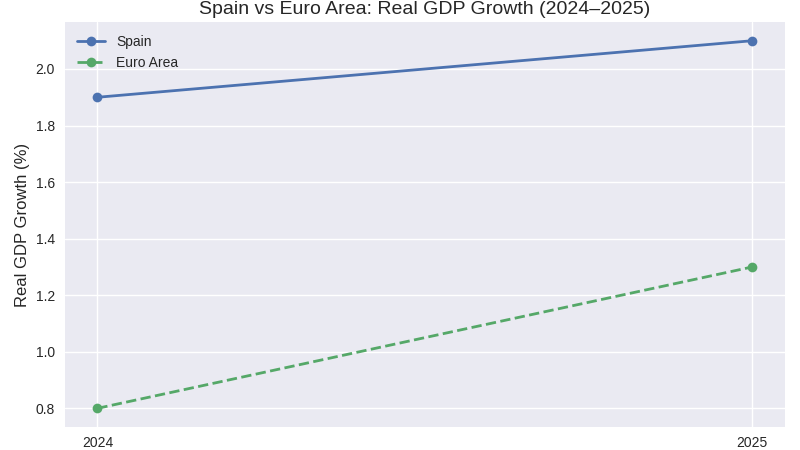
- Spain: 2.4% (2024), 1.9% (2025)
- Euro area: 0.8% (2024), 1.5% (2025)
The data confirm that Spain economic growth will remain above the euro area average through 2025, even as the pace moderates.
Policy Implications and Outlook
Spain’s trajectory offers valuable lessons for European policymakers. Migration, when paired with effective labour market integration, can be a growth policy rather than a political liability. Balanced wage dynamics preserve competitiveness while sustaining demand. Diversification beyond tourism strengthens resilience, while fiscal prudence and external debt reduction underpin credibility.
Altrom assesses that Spain will maintain growth above the euro area average through 2026, provided political stability is preserved and migration policies remain effective. The triple credit rating upgrade underscores that Spain economic growth is not a temporary rebound but a structural shift, positioning the country as a model for inclusive and resilient growth in Europe.