Key Summary
- EPA to cut 23 % of staff and shut its Research and Development office under broader government downsizing
- Moves save about $748.8 million but end key pollution, health and climate research, eliminating 3,700 of 16,155 positions
- Agency to establish an Office of Applied Science and Environmental Solutions in place of the research arm
- Democrats and scientists warn cuts will harm public health, safety and expose EPA science to political influence
- 2024 was the hottest year on record at 1.28 °C above the 1951–1980 baseline and June 2025 was Europe’s hottest June ever
- US retrenchment contrasts with EU’s proposed 90 % GHG cut by 2040, UK warnings on extreme weather and UN calls for faster clean‑energy transition
Washington’s Climate Science Shake-up
On July 18, 2025, EPA Administrator Lee Zeldin announced that the agency would slash its staffing by nearly one quarter and terminate its entire Office of Research and Development (ORD). The ORD, often called EPA’s scientific arm, employs about 1,500 of the agency’s 16,155 staff (as of January 2025) and conducts vital research on pollutants, health risks, and environmental impacts. The cuts will reduce EPA to roughly 12,450 employees and save about $748.8 million.
In a statement, Zeldin framed the move as fiscal responsibility: EPA is “better equipped than ever to deliver on our core mission of protecting human health and the environment while powering the Great American comeback”. The agency also announced creation of a new Office of Applied Science and Environmental Solutions, intended to handle applied research and technology transfer. But it did not explain how key scientific functions will be preserved. Neither did it specify how many ORD employees will be offered voluntary buyouts or early retirements versus being laid off.
The number crunch behind this downsizing is stark. In January 2025 EPA had 16,155 employees; cutting 23% means roughly 3,700 jobs vanish. In practice, this included all planned attrition and four rounds of voluntary separation offers. EPA says staff will fall to about 12,448 by late July. This is on top of earlier personnel changes after the 2024 election. The cuts would eliminate a wide range of scientific projects. Among the affected work was ongoing EPA research on ‘forever chemicals’ (PFAS), on respiratory illness in the rural South, and on the ecology of valley fever – all areas where up-to-date data guides policy.
These research streams are often underappreciated links between environmental conditions and public health. For instance, valley fever (a fungal respiratory disease) is aggravated by wildfires and drought – phenomena tied to climate change. PFAS (“forever chemicals”) are persistent pollutants with emerging health concerns. Elimination of ORD means fewer agency scientists monitoring contamination, modeling climate impacts, and validating new environmental technologies. As one EPA employee group warned, pushing ORD scientists into dispersed program offices “will make EPA science more vulnerable to political interference” – undermining its objectivity.
The announcement has provoked a sharp political backlash. Democratic lawmakers blasted the cuts as an ideological purge. Rep. Zoe Lofgren (D-CA) said EPA is “firing hardworking scientists while employing political appointees whose job it is to lie incessantly”. She called the closure of the ORD “a travesty” that will have “generational impacts on Americans’ health and safety”. Environmental justice and public health advocates echoed these warnings: closing EPA’s labs, they argue, removes an early-warning system for toxic threats.
Meanwhile, the administration’s response is that climate science is not left out entirely. Zeldin reiterated that protecting human health and environment remains the EPA’s top mission, and touted “Powering the Great American Comeback” by cutting overhead. The agency also announced a third round of voluntary exits that could shrink staff further, plus a shift to smaller, mission-driven science teams. But neither internal documents nor public statements detail how critical long-term studies will continue.
Global Warming Trends: Data and Visualization
This management shake-up comes amid alarming climate trends. In fact, late June 2025 data show a planet already far beyond the goals EPA (or any agency) is set to protect. According to NASA’s latest analysis, Earth’s 2024 surface temperature was the highest ever recorded, 1.28 °C above the mid-20th-century baseline. NOAA independently found 2024 to be 1.46 °C above the 1850–1900 average – the greatest anomaly since modern recordkeeping began in 1850. And crucially, every one of the 10 warmest years on record has occurred in the last decade. These figures underscore the urgency behind climate research and adaptation planning.
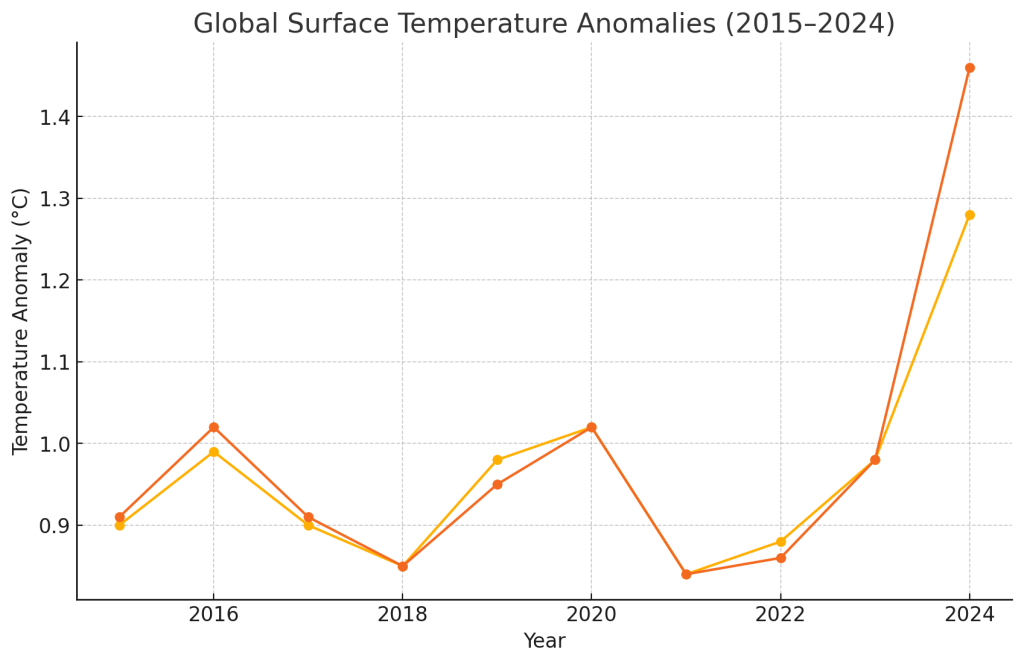
Figure: Global surface temperature anomalies in 2024 relative to the 1951–1980 average. Red and orange areas indicate regions far warmer than the baseline. NASA reports that 2024 was the warmest year on record, reflecting the unprecedented global warming illustrated here.
The embedded map (Figure above) comes from NASA’s GISTEMP dataset and highlights how widespread the warming is. By 2024, large swaths of land and ocean were multiple degrees (°C) above the 1951–80 average. In many regions (Arctic, North America, Europe, Africa, Asia), 2024 ranked as the warmest year yet on record. (Even ocean surfaces set records; overall, NOAA notes 2024 was a global sea-surface temperature high.) Notably, recent research links extreme heat to deadly consequences: a Copernicus/Imperial College analysis estimated 2,300 heat-related deaths in a June 2025 European heatwave, about 1,500 of which are attributable to climate change’s extra warming.
In this context of record-breaking climate stress, many observers see U.S. research cuts as ill-timed and dangerous. The climate science community warns that every fraction of a degree of warming must be understood and mitigated. The EPA’s role in collecting localized climate data (e.g. flood plain studies, health risk assessments) is one of many inputs to national policy on disaster preparedness and environmental justice. By shrinking that role, the U.S. weakens its ability to forecast and adapt to climate-fueled disasters, even as such events intensify.
International Policy Context: U.S. Retreat vs. Global Action
The EPA downsizing stands out when compared to policies elsewhere. Global climate rhetoric in this period has been markedly different. On July 22, UN Secretary-General António Guterres addressed the UN General Assembly on climate, urging nations to “go all-out” on a renewable energy transition. He emphasized that moving “from fossil fuels towards renewables… is a game-changer” and that current pledges are still “not fast enough or fair enough”. Guterres called for bold new Nationally Determined Contributions (NDCs) by September 2025, as the world enters the critical countdown to COP30.
Meanwhile, key economies are stepping up ambition. In early July 2025 the European Commission unveiled an amendment to the EU Climate Law, setting a 2040 emissions target of 90% below 1990 levels. This proposed target goes beyond the current 55% by 2030 goal and is meant to guide policy toward net-zero by 2050. Likewise, the UK government in mid-July published its first annual “State of Climate and Nature” statement. Citing the Met Office, it warned that “the UK’s climate is getting hotter and wetter, with more extreme weather events”. The UK report also detailed unprecedented investments: for example, a £7.9 billion flooding programme over ten years – “the largest flooding programme in history” – aiming to protect homes and infrastructure from increasing downpours.
European and other governments are also wrestling with how to finance these ambitions. Just days earlier, the European Commission proposed a major overhaul of the EU multi-year budget. In that proposal, dedicated funding lines for biodiversity and climate adaptation were merged into a broad “Competitiveness Fund,” sparking criticism. NGOs warned that absent earmarking, “biodiversity will be sidelined in favour of industrial priorities”, even as the EU claims it will devote 35% of its €1.8 trillion budget to Green Deal goals. In this debate, even European policymakers admit there is already a €37 billion annual gap in funds for nature restoration. The point is that elsewhere, climate and environmental science are being integrated into policy plans, for better or worse – but in the U.S., the very institutional capacity to generate that science is being gutted.
Implications and Risks
Cutting the EPA’s research capacity carries far-reaching risks. In the short term, gaps will appear in federal reports and risk assessments. For example, closing the ORD lab in Research Triangle Park (NC) or the lab in Cincinnati means losing expertise on how airborne pollutants travel or how ecological changes affect human health. Without that analysis, regulatory decisions (on water safety, air quality, etc.) may rely more on outdated data or outside consultants. Over time, scientific specialization will be lost: junior scientists will leave, senior researchers will retire early, and corporate or academic labs may be the only source of environmental monitoring.
The timing is also perilous. The United States currently holds a stated target under the Paris Agreement to cut emissions (its NDC). Meeting that target – and updating it post-2030 – will require hard data on emission sources and sinks. Yet the EPA is traditionally responsible for emissions inventories and modeling. Demolishing its research office reduces oversight of pollution from industry, agriculture, and new sources. That undermines both climate mitigation and compliance with environmental laws. It may also hinder adaptation planning: for example, the EPA helps fund and analyze weather-related health data that cities and states use to prepare for heatwaves and floods.
On the foreign-policy front, the move could damage U.S. credibility. American environmental research agencies (EPA, NOAA, NASA) have long provided data to international assessments (like the IPCC) and to developing countries. If the U.S. no longer generates unbiased findings on pollutants or climate trends, it cedes leadership to others. For instance, data on air quality used in global models partly came from EPA networks. Without it, global models would be less accurate. Allies may perceive the U.S. as less committed to evidence-based policymaking. Meanwhile, rival nations with state-controlled science (e.g. China, Russia) may exploit the scientific void.
There is also a domestic political risk. Public awareness of climate impacts is growing: recent polling shows large majorities of Americans see climate change as a serious problem. Voters may view these cuts as out-of-touch with reality. Indeed, one indicator – two-thirds of Americans now support transitioning off fossil fuels, according to a Pew survey (July 2025). If federal science is seen as undermining that transition, it could trigger legal challenges. Several environmental laws require science-based rulemaking (e.g. Clean Air Act). Cutting the staff that implements those laws could invite lawsuits from states, NGOs, or even members of Congress. There is already a federal lawsuit under way to block EPA’s attempt to claw back billions in climate funding from states (a separate but related controversy involving Trump-appointed EPA).
Policy Analysis
Strengths: The administration argues these cuts will streamline EPA and save taxpayer dollars. If current EPA programs are poorly managed or duplicative, a tighter budget could force efficiency. The new “Applied Science” office suggests a focus on translating research into practical outcomes. In theory, concentrating on core regulatory goals (clean air/water) might concentrate resources on actionable tasks rather than blue-sky research. Some industry groups also favor smaller regulation budgets.
Failures: However, the downsides outweigh these gains. Key failures include: loss of institutional knowledge, reduced data for future policymaking, and erosion of environmental monitoring. Experts note that research grants and contracts cannot fully substitute for an in-house lab that sets its own agenda. Ad hoc fixes will likely cost more in the long run: for example, if the EPA no longer researches toxicity thresholds, it may have to rely on in-country or foreign studies to set pollution limits. The cuts also break a consensus that emerged post-2015 (Paris Agreement) that climate science must be a government priority.
Policy Options: Policymakers now face choices. Congressional action: Since EPA funding comes from Congress, lawmakers could restore personnel lines or require reporting on how environmental research gaps will be addressed. They might attach riders to appropriations bills forbidding EPA from eliminating certain programs (similar to how Congress blocked prior regulatory rollbacks). Administrative adjustments: The White House could direct EPA to publish a transition plan: how will research priorities be maintained? For example, new inter-agency collaborations (with NOAA, CDC, NASA) could be formalized. NASA and NOAA could be tasked with absorbing some climate monitoring roles. Legal avenues: Courts may evaluate whether the EPA is violating statutes by dismantling science offices essential for rulemaking under the Clean Air and Water Acts. Lawsuits could slow or reverse the cuts if it’s shown they undermine statutory mandates for environmental protection. Funding innovation: Congress could consider a separate climate science appropriation or incentive grants (e.g. through the National Science Foundation) to fund key climate projects lost at EPA. This would be an indirect fix but could mitigate gaps in monitoring or modeling.
Comparative perspective: In the UK and EU, policymakers are grappling with how to fund climate action, but they have generally reaffirmed science-led policies. The UK’s recent Climate Change Committee report (April 2025) warned that the UK’s current adaptation efforts are “inadequate” and mostly stalled, urging more investment. Britain’s Parliament just passed measures accelerating renewable deployment. The EU’s Green Deal legal framework is pushing for ever-stronger targets. These examples show that policy norms are moving toward more – not less – climate research and action. The EPA cuts put the U.S. at odds with this trend.
Looking ahead, if U.S. policymakers do not reverse or mitigate these cuts, the potential costs loom large. Climate disasters (wildfires, hurricanes, floods, heatwaves) cause tens of billions in damage annually in the U.S. (US insurers estimate $120 billion loss in 2021 alone). Insufficient science increases the chance of surprise: for example, without continuous research on methane leaks or forest carbon, the nation may miscalculate its greenhouse gas budget. On health, air pollution and heat kill thousands each year; EPA research underpins standards meant to keep those risks in check. Without vigilance, those standards may lag behind reality, costing lives.
Altrom Position & Outlook
Altrom analysis strongly goes against the EPA’s workforce reduction and the scientific office closure. These actions undermine the very foundations of sound environmental and climate policy. We urge immediate steps to restore and strengthen the country’s climate science capacity:
- Reinstate Funding for Climate Research: Congress and the administration must allocate sufficient funds to ensure continuation of critical EPA research programs. If the new leadership claims fiscal goals, Altrom suggests a targeted approach: restore the budgets of high-impact ORD programs (e.g. climate-health modeling, pollutant testing, ecosystem impact studies) and defer or cancel less-essential initiatives. Any cost savings from cuts should be re-invested in modern monitoring infrastructure (e.g. expanded satellite observation, community air-quality monitors) to keep U.S. science robust.
- Ensure Scientific Integrity: Legislation or executive orders should guarantee EPA scientists can speak about their findings without political interference. As a start, Altrom proposes establishing an independent review board to audit EPA research plans annually. This board, composed of scientists and stakeholders, would ensure continuity of long-term studies. Altrom also supports the “Standards of Ethical Conduct” for government scientists, extended to cover all divisions, to protect them from retaliation (as has occurred with the recent dissent declaration issue).
- Leverage Partnerships: In the vacuum left by EPA’s cuts, federal climate leadership can shift to other entities. Altrom encourages strengthening interagency collaboration: NOAA, NASA (GISS), USDA, and DOE each have climate data programs. A coordinated federal Climate Research Consortium could pool resources and maintain data sharing so that no essential observation network is lost. Altrom suggests designating NASA or NOAA as a central climate data authority, with a mandate to fill gaps in EPA’s former role.
- International Leadership: Rather than retreat, Altrom calls for the U.S. to re-engage globally. The administration should reaffirm any remaining commitments under the Paris Agreement and collaborate on international research initiatives. For example, the U.S. could join a new international effort to monitor extreme events (heatwaves, floods) in real time and share early warning information. The EU’s proposed 90% target by 2040 and the UK’s integrated climate-nature strategy show that strong leadership is possible. Altrom sees an opportunity for U.S. agencies to partner on these European initiatives, exchanging data and co-funding research that serves both sides of the Atlantic.
- Congressional Oversight: We also urge Congress to use its oversight authority. Congressional hearings should be held to question how EPA and the administration plan to meet environmental mandates without scientific staff. Altrom supports legislative language that ties EPA appropriations to performance goals (e.g. maintain data quality, keep response times to incidents short). If needed, Congress should pass narrow bills preventing the dismemberment of offices explicitly charged with air, water, and climate monitoring.
Ultimately, Altrom emphasizes that leadership matters in a climate crisis. By contrast with the current U.S. policy direction, governments that integrate climate science into decision-making stand to reap economic and security benefits. Clean energy economies depend on reliable data for investment decisions. Infrastructure planning (ports, power plants, public health) needs updated climate risk assessments. In these areas, the U.S. should be a leader, not an outlier.
In conclusion, Altrom calls on U.S. policymakers to reverse course: protect scientific institutions, restore environmental R&D funding, and recommit to the evidence-based approach that has long characterized successful climate strategy. The cost of inaction – or regression – is high in human lives and economic damage. By acting now to safeguard climate science, the United States can turn this moment of crisis into an opportunity to lead once again in global climate solutions, collaborating with the EU, UK, and others to secure a safer future for all.